


Views: 0 Author: Site Editor Publish Time: 2026-09-09 Origin: Site


Architects and builders increasingly choose frameless glass structures for their clean, modern appeal, but achieving that minimalist look requires hardware that can handle real structural loads without visual clutter. Spider glass fitting systems solve this problem by anchoring large glass panels to steel or concrete supports through a network of stainless steel arms, creating facades, canopies, and partitions that look almost weightless while remaining structurally sound.
Companies like INF Hardware, part of Jiangmen Infinity Import and Export Co., Ltd., have spent years refining these systems for commercial and residential projects around the world. Their production facility in Guangdong Province combines precision manufacturing with rigorous quality assurance, giving architects and contractors hardware they can specify with confidence.
This post breaks down what spider glass fitting systems are, how they compare to other glass fitting solutions, and what factors matter most when selecting the right hardware for a project.
A spider fitting is a multi-armed bracket, usually with two, three, or four legs, that connects glass panels at their corners to a structural frame. The design distributes weight and wind load evenly across each connection point, which allows glass panels to span larger distances than traditional framed systems permit.
Unlike bolted patch fittings that sit flush against a single glass edge, spider brackets extend outward from a central hub, giving engineers more flexibility in how loads travel through the structure. This makes them a preferred choice for building facades, atrium roofs, and pedestrian bridges where both strength and transparency matter.
Most manufacturers produce these brackets from 304 or 316 stainless steel, chosen for corrosion resistance and long-term durability in outdoor environments. Some premium lines also offer brass or aluminum alloy options for interior applications where a different finish is desired.
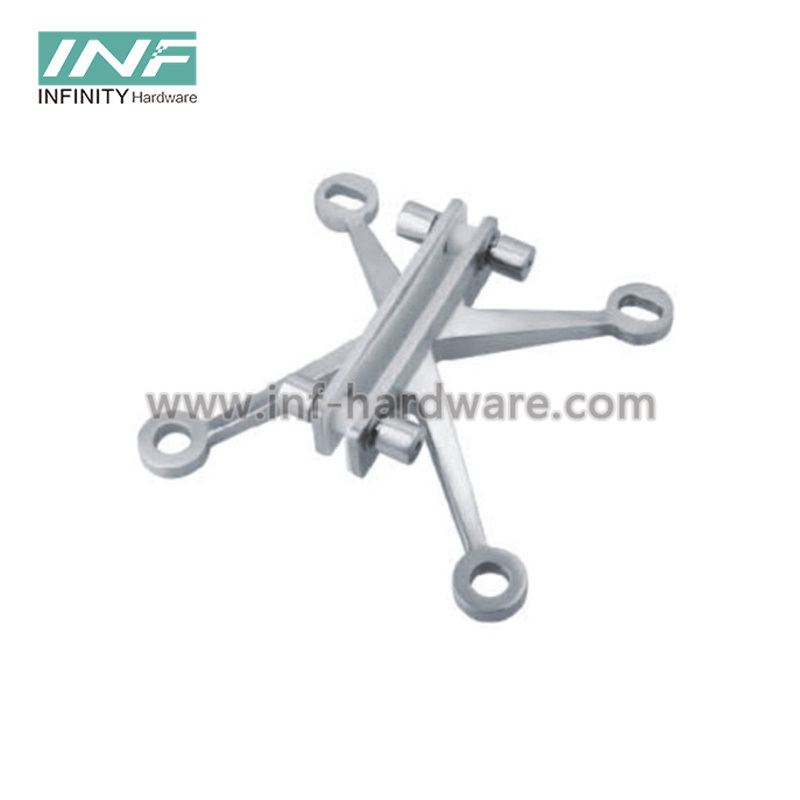
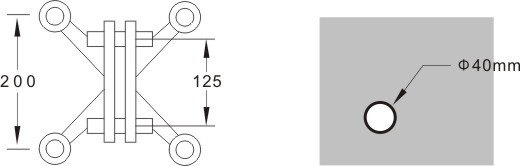
Spider glass fitting hardware shows up in a wide range of settings, though it tends to deliver the most value in projects where visual openness is a priority. Common applications include:
Curtain wall facades on commercial towers
Glass canopies over entrances and walkways
Skylights and atrium roofing systems
Structural glass fins and partitions
Aquarium and display enclosures requiring large, seamless glass panels
In each case, the hardware needs to be rated for the specific load conditions of the site, including wind pressure, seismic activity, and thermal expansion. Engineers typically calculate these loads before selecting a bracket configuration, since undersized hardware can lead to glass cracking or joint failure over time.
Selecting the right hardware depends on the project's structural requirements, aesthetic goals, and budget. The table below outlines how spider fittings stack up against other frequently used options.
Hardware Type | Typical Load Capacity | Visual Profile | Best Suited For |
|---|---|---|---|
Spider fitting (2-4 arm) | High | Minimal, open | Facades, canopies, atriums |
Patch fitting | Medium to high | Compact, flush | Entrance doors, partitions |
Glass clamp | Low to medium | Visible bracket | Balustrades, small panels |
U-channel framing | Medium | Framed edge | Shower enclosures, railings |
As the table shows, spider fittings tend to offer the highest load capacity while keeping the visual profile to a minimum, which explains why they're so common on large-scale architectural glass installations.
The performance of any glass fitting hardware comes down to the quality of the raw material and the precision of the manufacturing process. Stainless steel 304 offers solid corrosion resistance for most environments, while 316-grade steel holds up better in coastal or high-humidity regions where salt exposure accelerates rust.
Beyond material grade, the casting and finishing process matters just as much. Poorly finished brackets can develop stress points that weaken over time, especially in outdoor installations exposed to temperature swings. Reputable manufacturers test their hardware against several quality assurance benchmarks before it ships, which reduces the risk of failure after installation.
Buyers should also confirm how the bracket's arms attach to the glass. Some systems use through-bolt connections that pass directly through drilled holes in the glass panel, while others rely on clamping mechanisms that avoid drilling altogether. Each approach has trade-offs in terms of installation time, load distribution, and the ability to replace a damaged panel later.
Because spider glass fitting hardware plays a direct role in structural safety, sourcing from an experienced manufacturer matters as much as the product specifications themselves. A supplier with a dedicated production facility, an established quality assurance process, and a track record across bathroom and architectural hardware categories, like INF Hardware's combined focus on sliding door fittings, hinges, handles, and glass connectors, brings more consistency to large orders than a smaller operation working with limited equipment.
Before finalizing a supplier, project teams should ask for load testing documentation, finish samples, and references from comparable installations. These details reveal whether a manufacturer's claims match their actual production capacity.


Spider glass fitting systems give architects a way to combine structural performance with the open, transparent look that modern glass buildings demand. Getting the details right, from material grade to bracket configuration, makes the difference between a facade that lasts decades and one that requires costly repairs.
Project teams evaluating hardware options should compare load ratings, finish quality, and supplier track record before committing to a system. Reviewing a manufacturer's full product catalog and production capabilities is a practical first step toward specifying hardware that will perform reliably for years to come.


